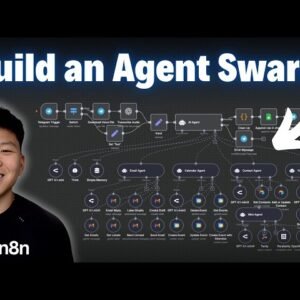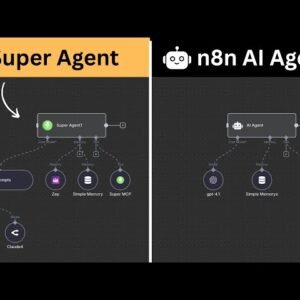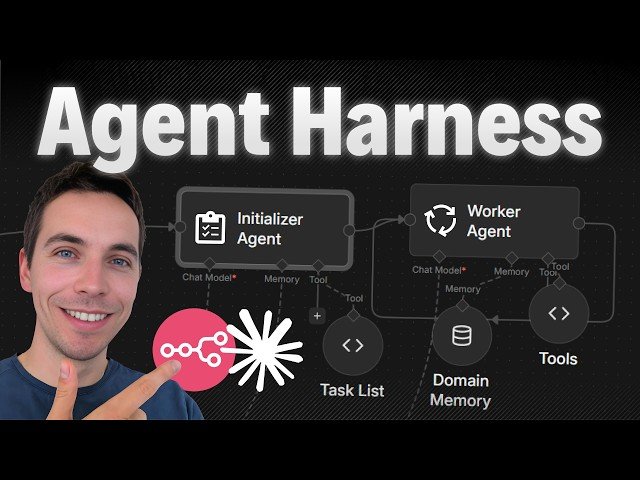
This video explains how to build an agent harness: a control layer that enables AI agents to plan, persist state, and execute long-running, multi-step projects. It demonstrates a deep-research workflow in NHN with database schemas, task orchestration, retrieval strategies, progressive summarization, and final report delivery. The presenter compares sequential, concurrent, and hybrid patterns and highlights key architecture questions for durable agents.
– Agent harness concept: Defines an external scaffolding that creates plans, breaks work into tasks, persists state/artifacts in a database, and recovers across executions.
– Workflow example: Shows an initializer creating 20+ tasks (retrieval, synthesis, write), a task worker harness that locks jobs, executes tasks, stores artifacts, and marks progress.
– Persistence & memory: Covers job/task tables, artifact staging, progressive summarization, checkpoints, and audit logs to maintain long-running context.
– Concurrency & patterns: Compares single-task execution, parallel retrieval orchestrators, hybrid flows, dependency graphs, and test-driven or human-in-the-loop stop conditions.
Quotes:
Most AI agents you see demoed online can’t handle complex or long-running projects.
An agent harness is a control layer or scaffolding for your AI agent.
You can’t just throw away the scaffolding and rely on the AI agents themselves.
Statistics
| Upload date: | 2025-12-18 |
|---|---|
| Likes: | 363 |
| Comments: | 18 |
| Statistics updated: | 2026-01-16 |
Specification: Unlock DEEP AGENTS with Anthropic’s Agent Harness in n8n
|