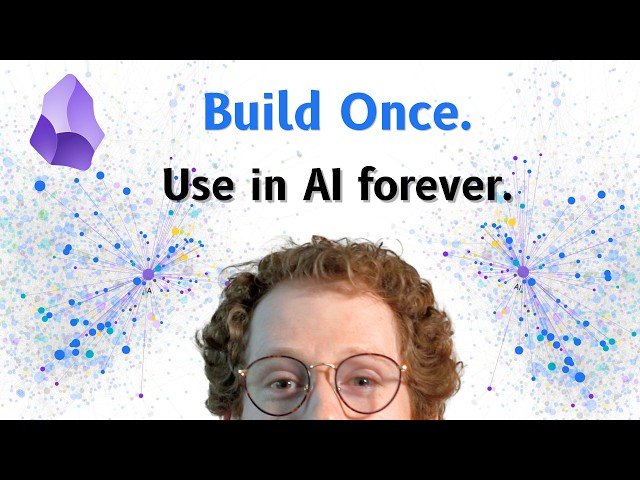
This video explains building personal and agentic knowledge graphs (LLM Wiki) to structure information for human and AI use. Callum demonstrates nodes, edges, triples, scaling a personal Obsidian graph, and how graph-based RAG improves AI retrieval. He contrasts human and agent vaults and outlines an automated LLM Wiki workflow for ingestion, integration, and maintenance.
- Core model: Nodes, edges and triples are the atomic units that form a scalable knowledge graph.
- Practical build: Live Obsidian demo shows how linking notes creates a compounding personal graph over years.
- AI integration: Standard RAG works for single-document answers; graph RAG outperforms it for reasoning across connected sources.
- LLM Wiki workflow: Layered approach—raw sources, AI-compiled interlinked wiki, and agent-driven maintenance keeps the shared knowledge current and usable by multiple tools.
Quotes:
Google built one for the entire internet. I built one for my own brain.
A triple is the atom of a knowledge graph: subject, relationship, and object.
The LLM reads sources, extracts key information, and integrates it into a persistent wiki – knowledge compiled once and kept current.
Statistics
| Upload date: | 2026-04-25 |
|---|---|
| Likes: | 3658 |
| Comments: | 347 |
| Fan Rate: | 4.49% |
| Statistics updated: | 2026-05-22 |
Specification: Why LLM Wiki? Future Of Knowledge For Agentic AI & Humans
|

Why LLM Wiki? Future Of Knowledge For Agentic AI & Humans